Claude Cowork vs Codex: Which One to Use

Claude Cowork vs Codex looks like a straight fight, but the two were built for different work. Cowork is Anthropic's agent for knowledge work: research, documents, spreadsheets and decks, run in Anthropic's cloud. Codex is OpenAI's agent for working inside a folder or a codebase, and it now lives inside ChatGPT on desktop, web, mobile, the terminal and code editors.
Pick Claude Cowork for errands that end in a document, deck or spreadsheet, started from any device and finished in the cloud. Pick Codex for work inside a folder or codebase on your computer, especially if you already pay for ChatGPT. For the closest like-for-like match, compare Cowork with ChatGPT Work, and Codex with Claude Code.
Every product fact below comes from Anthropic's and OpenAI's own pages, checked on November 18, 2026. Both change monthly, so the sources are linked.
Claude Cowork vs Codex at a glance
 Claude Cowork
 Codex
| Claude Cowork | Codex | |
|---|---|---|
| Made by | Anthropic | OpenAI |
| Built for | Non-coding knowledge work: research, analysis, documents | Work in folders and codebases, plus tasks in ChatGPT |
| Where the work runs | Anthropic's cloud, an isolated environment per session | Your computer in the folder you open, or Codex Cloud |
| Where you use it | Desktop app, claude.ai, the mobile apps, the Chrome side panel | ChatGPT desktop app, web, mobile, the CLI, IDE extensions |
| Standing instructions | Global and folder instructions | AGENTS.md files |
| Skills | The skills enabled on your claude.ai account | Skills and plugins, called with $ |
| Scheduled work | Scheduled tasks, run in the cloud | Scheduled tasks; local ones need the computer on and the app open |
| Permissions | Manual and Auto modes; asks before permanent deletes | Read-only, workspace and full-access profiles |
| Plans | Pro, Max, Ultra, Team, Enterprise (not the free plan) | Limited on Free and Go; Plus, Pro, Business, Enterprise |
What Claude Cowork is
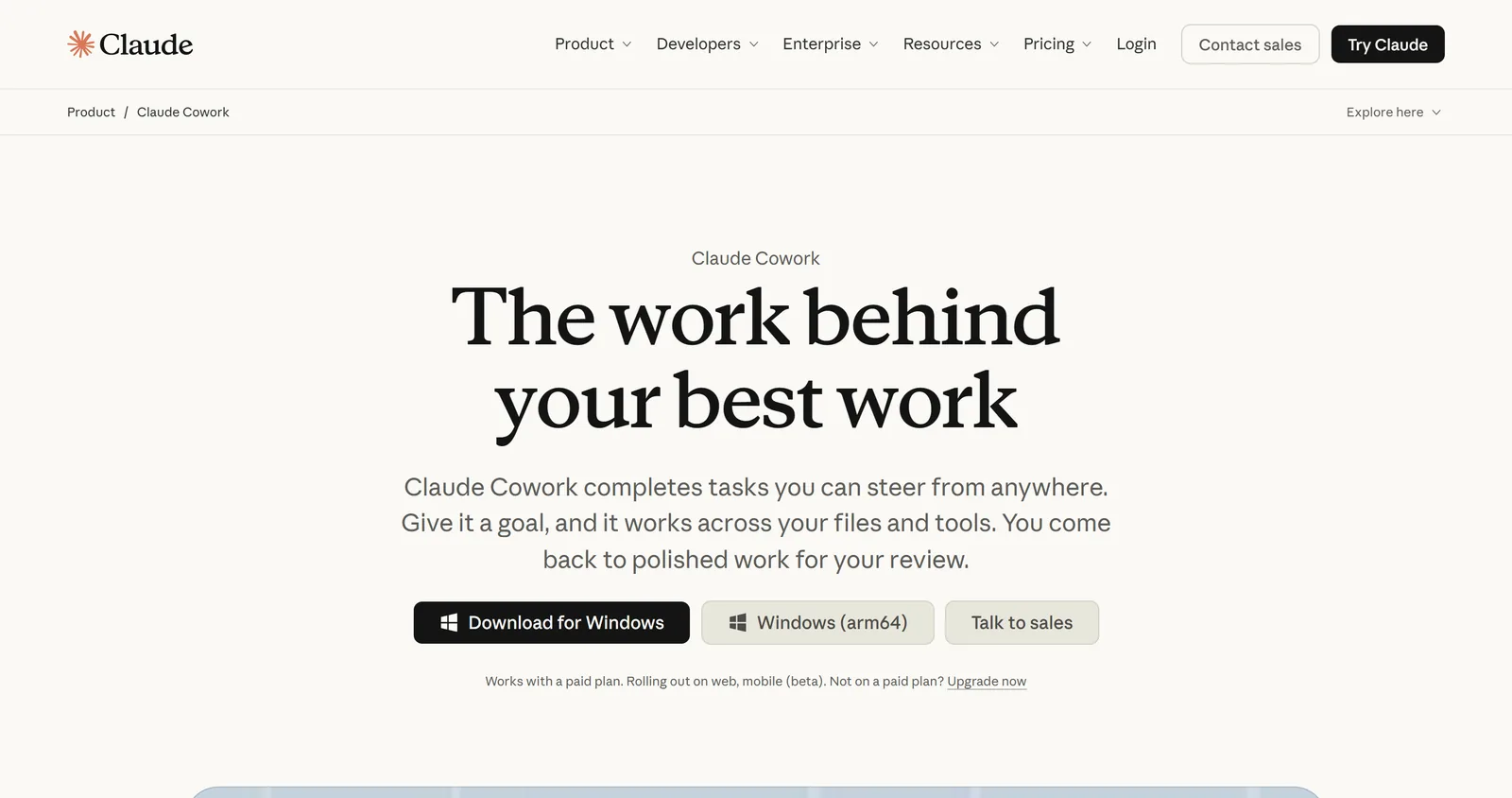
Anthropic's Cowork product page draws the line itself: Claude Code is for software engineering, and Cowork is for non-coding knowledge work. You describe an outcome, Claude plans the steps, splits big jobs into parallel subtasks and hands back finished files.
What matters for this comparison:
- It runs in the cloud. Each session gets an isolated environment on Anthropic's servers, so work continues when you close the laptop, per Anthropic's help center.
- It reaches your computer only through the desktop app. Connected folders, the built-in browser and computer use need the app open.
- It uses your account's skills and connectors. Whatever you enabled under Customize on claude.ai. Its docs say it does not read the
~/.claudefolder Claude Code uses. - It is merging with chat. On Pro, Max and Ultra, chat and Cowork are moving into one home where Claude decides whether a message is a quick answer or a task.
For the first jobs to hand it, read Claude Cowork for business owners.
What Codex is
OpenAI's Codex docs now sit inside ChatGPT's own documentation, and the overview frames it as: start with a goal, and ChatGPT gathers context, takes action and produces something useful. OpenAI merged the Codex app into the ChatGPT desktop app, where a toggle above the message box switches between Chat and Work.
What stands out:
- It works where your files are. The desktop app for macOS, Windows and Linux lets you open a folder and use the files in it. The CLI and the IDE extensions do the same from the terminal and your code editor.
- Or in the cloud. Codex Cloud gives each task its own workspace that keeps working while your computer is asleep, and can check out repositories from GitHub or GitLab.
- `AGENTS.md` instructions. Codex reads standing instructions from
AGENTS.mdfiles, the way Claude Code readsCLAUDE.md. - Skills and plugins. A skill packages instructions and resources for one workflow; a plugin bundles skills and MCP servers. You call a skill with
$or let Codex pick it. - Permission profiles. Local commands run in a sandbox with a read-only, workspace or full-access profile. Workspace lets it write only inside the project and temporary folders.
If you know Claude Code, Codex will feel familiar: a folder, an instruction file, skills and a sandbox.
Where each one runs, and why it matters
- 1
Cowork
Anthropic's cloud, an isolated workspace per session
- 2
Cowork on your computer
connected folders and the browser, through the open desktop app
- 3
Codex locally
the folder you open, in the ChatGPT desktop app, CLI or editor
- 4
Codex Cloud
its own workspace per task, running while your computer sleeps
Cowork's default is the cloud and its home is documents. You hand it a goal from your phone, close the laptop and come back to a finished file.
Codex's default is the folder on your machine. The work lands as files and changes in that folder, which is why it suits code, websites and anything you build. Codex Cloud covers the hand-it-off-and-leave case, mostly for repositories.
Scheduling follows the same split. Cowork's scheduled tasks run in the cloud with no device online. OpenAI's scheduled tasks guide says a Codex task that needs local files needs the computer on and the app running, and a task started on the web cannot work in a folder on your computer.
How much each one costs
Claude Cowork comes with every paid Claude plan, per Anthropic's pricing page: Pro at $20 a month or $17 a month billed yearly, Max at $100, Ultra at $200, Team from $20 a seat billed yearly and Enterprise from $20 a seat plus usage at API rates. The free plan does not include it. The full table is in Claude Cowork vs Claude Code.
Codex comes with ChatGPT plans, per OpenAI's Codex pricing page, in US dollars:
| ChatGPT plan | Price | Codex |
|---|---|---|
| Free | $0 | Desktop app, limited, subject to rollout |
| Go | $8 a month | Desktop app, limited, subject to rollout |
| Plus | $20 a month | Web, CLI, IDE extension, iOS and cloud integrations |
| Pro | $100, $200 or $500 a month | Everything in Plus, with more usage |
| Business | $20 a user a month billed yearly ($25 monthly), 2 users minimum | Desktop and mobile apps |
| Enterprise and Edu | Contact sales | Included, with admin controls |
You can also run the Codex CLI, SDK and IDE extension on an OpenAI API key, billed at API rates, without the cloud features.
Usage is the hidden cost on both. Anthropic says Cowork uses limits faster than chat, because one task runs many steps. OpenAI says Codex and ChatGPT Work share one usage limit, and weekly limits can apply on top.
Which one I would use for business work
| Job | Pick |
|---|---|
| A research summary, deck or spreadsheet done while you are out | Cowork |
| Work across Google Workspace or Microsoft 365 files | Cowork |
| A website, landing page, calculator or script | Codex |
| A weekly job that reads and writes the same folder of business files | Codex, or Claude Code |
| You already pay for ChatGPT and not Claude | Codex, and ChatGPT Work for errands |
| You already pay for Claude and not ChatGPT | Cowork, and Claude Code for folders |
The honest answer for most owners: pick the company you already pay, then use its two agents for what each does best. On Claude, that is Cowork for errands and Claude Code for the system. On ChatGPT, it is ChatGPT Work for errands and Codex for folders. I compare those pairs in Claude Cowork vs ChatGPT and Claude Cowork vs Claude Code.
Building software or client projects? The developer comparison, Claude Code vs Codex, is on Stride AI Academy, my community for people building AI services. Running an always-on assistant instead? Read Claude Cowork vs OpenClaw. More pairings are on my AI tool comparisons page.
Claude Cowork vs Codex: FAQ
Is Codex the same as ChatGPT Work?
Codex and ChatGPT Work are separate parts of ChatGPT that share one usage limit. Codex works in folders and codebases on your computer or in Codex Cloud. ChatGPT Work is OpenAI's agent for long, multi-step business tasks across your apps and files, the closer match to Cowork.
Is Codex better than Claude Cowork?
Neither is better across the board. Codex is stronger for work inside a folder or codebase, like pages, scripts and files you build. Cowork is stronger for research, documents, decks and spreadsheets you hand off and collect later.
Can Codex do non-coding work?
Codex can work on any files in a folder, so it can draft documents, clean up data and run file-based workflows. For errands across your apps, OpenAI's own non-coding agent is ChatGPT Work, in the same desktop app.
Is Codex free?
Codex has limited access on ChatGPT Free and Go in the desktop app, subject to rollout. Plus at $20 a month adds the web, CLI, IDE extension, iOS and cloud integrations, per OpenAI's Codex pricing page in November 2026.
How much does Claude Cowork cost?
Cowork is included in every paid Claude plan, starting with Pro at $20 a month ($17 a month billed yearly). Max is $100 a month and Ultra is $200 a month, both with more usage. The free plan does not include it.
Can I use the same skills in Cowork and Codex?
Both use skills built from instructions and resources, but you add them separately. Cowork loads the skills enabled on your claude.ai account. Codex loads its own skills and plugins and reads AGENTS.md files in your folder.
Run the same jobs in either
The AI Operator Kit gives you five systems for content, leads, outreach, sales and building, a daily operator plan and 107 prompts sorted by job. It runs in Claude Code, Codex and Cursor, and in the Claude or ChatGPT app on your phone.


